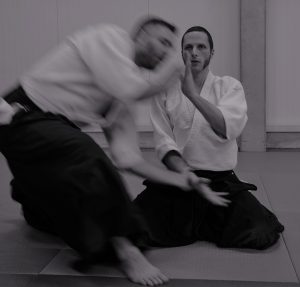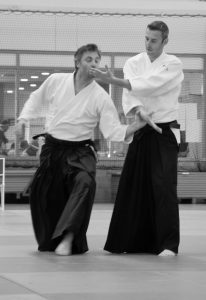
Katsuyuki Shimamoto Shihan

Katsuyuki Shimamoto shihan was een invloedrijke aikidoleraar en hoofdpriester van de Shosenji tempel en dojocho van Shosenji dojo in het Toyonakadistrict van Osaka, Japan[1].

Van 1950 tot 1956 beoefende hij de Okinawastijl van Shitoryu karate en haalde hij een nidan. Vanaf 1956 begon zijn aikidotraining aan Komazawa University. Hij lag er mee aan de basis van de nieuw opgerichte aikidoclub en ontmoette er zijn leraars, Suzuki Kakuzen en Kisaburo Osawa. In diezelfde periode woonde hij lessen bij in Honbu dojo, waaronder ook lessen onderwezen door Osensei Morihei Ueshiba.

Vanaf 1995 reist Shimamoto shihan naar het buitenland en richt hij Shoryukai op, de internationale tak van Shosenji dojo. Vandaag heeft shihan sattelietdojo’s in België, Duitsland, Israel, Nederland, Polen en Australië. Hij heeft ook een uitgebreid aikidonetwerk in Canada en Singapore.

Op 1 januari 2010 ontving hij zijn 8e dan van Moriteru Ueshiba.

Twee van onze eigen leraars, Jan Vanrompay en Robin Ruelens hebben in 2002 en 2003 een jaar in shosenji dojo getraind. Heel wat van onze yudansha volgen shihan al jaren op buitenlandse stages en hebben voor langere perioden in shosenji getraind.

Sinds 11 mei 2025 leeft Shihan voort in onze herinnering.


Though the water flows swiftly, the moon remains still—My Life with Aikido

                                                                                   Katsuyuki Shimamoto

Shedding One’s Old Skin from Moment to Moment

I was born in a family who serves in a temple and turn eighty-eight this year. For seventy years I have pursued the spirit of Aikido and lived with it. First of all, I am deeply grateful that I was lucky enough to come across Aikido and have been able to continue practicing it.

When I started Aikido, I was just obsessed with “winning”. Then, the late Kisaburo Osawa-sensei told me: “strength in Aikido does not exist in defeating your opponent. I think it’s about finding the dirt and flaws that have ingrained in yourself, facing them without fear, trying to sort them out and cleaning them up.”

After graduating from university, I was allowed to open a dojo in Osaka.
My students were neighborhood children and they called me “big brother”. I knew that I was not yet qualified to be called “shihan”, so that was completely fine with me.
My dojo was a converted book storeroom, which had wooden floor, on our property. It hurt a lot when thrown onto the wooden floor, so we used to go outside to practice in the yard. It took years for the tatami mats to be installed, but I was thankful to be able to practice Aikido without worrying about the costs of running the facility.

About sixty years ago, we held a winter training camp in Minoh city, Osaka, for two days in February. We had an evening practice in a freezing cold gymnasium, and got up early for early morning practice which included running to Minoh Falls, sitting in seiza for half an hour, then doing outdoor practice at Ryuanji Temple, where the ground was completely covered with snow. It was so cold that there was no second time.

For a summer training camp, we chose Kasumi, Hyogo Prefecture. Evening practice took place in a temple ground while morning practice in a shrine ground, both grounds fully graveled. This time, it was a battle against heat and pain due to the gravel. As a conclusion of the four-day training, we sat and practiced on the beach. The sand was so soft and smooth that it made us feel like we were in paradise. This annual training camp has continued for over thirty years, with some years seeing over eighty participants.
Then we switched the venue of the training camp to Tenkawa Daibenzaiten Shrine in Nara, where my cousin, Mr. Mikinosuke Kakisaka, serves as a priest. The shrine has a Noh stage which is one of the most historical Noh stages across Japan, and they kindly offered us the use of the Noh stage so that all participants could perform dedication demonstration.


Although the tradition of training camp which began from Minoh winter camp, followed by Kasumi, then Tenkawa summer camp had to be unfortunately interrupted due to the COVID-19 pandemic, all the experience and memories of training camp became a significant milestone in the history of the Shosenji dojo.

As I spent time with neighborhood children and adults through practice, I eventually began to be called “shihan.”
As a result, I felt I could not fail in front of students, so when I made a mistake, I tried to cover it up with my next move. It wasn’t until I turned sixty that I became able to honestly tell my students that I made a mistake and discuss with them how we could improve it next time. Failure is embarrassing, but I accepted it as unavoidable and decided to use my failed techniques as teaching materials. “Don’t try to copy my move. Honestly, it was a mistake. Everyone, please take a closer look. Instead, why don’t we change it in this way so that we don’t make the same mistake again?”
My students watched me intently and witnessed how I got over the precipice. In fact, I don’t call them students. I respectfully call them “nakama (friends)” who practice and walk the path together.

Each time we practice a technique, I further add subtle movements to reflect the essence of Aikido. As I continue to hone my mind, technique, and body, new challenges keep arising one after another. Every time I encounter a challenge, I need to think carefully about it. Then the answers will emerge naturally during practice. With each passing moment, We shed our old selves.
“Compare these two movements,” I call to my nakama in the dojo. They surround me like a crowd gathering around attractions at a festival.
“It is said that a magic trick won’t work if you look at it from behind, but I want you to watch how I execute the technique from the front and the side, all directions.”
My nakama focus their gazes intently on my every movement, and over time they understand.
Thus, I found myself achieved eighth dan and was honored to be awarded as Person of Merit in Budo (Martial Arts). The Osaka Aikido Federation was founded and supporters gradually increased, as such Osaka aikido began to spread around the world.

My nakama who come all the way from overseas make the most of every second looking at my Aikido with earnest eyes. They are determined to learn as much as they can before returning home.
My nakama come from countries like Israel, Poland, and Belgium, not all of whom live in blessed environment. One country has a sad history of occupation, while others are currently experiencing the ravages of war. Perhaps that’s why they seek salvation in the spirit of Aikido. They arrive at the airport with passion and desire for learning in their hearts.
They rent cheap rooms and come to the dojo every day, carrying their heavy dogi (training clothes). After evening practice, they clean up with other nakama and head home around nine o’clock. By that time, many restaurants nearby are closed, so they have to buy food at convenience stores. They continue this kind of life for about a week and leave for their country after giving a beautiful greeting with invigorating smile.

Some of them reluctantly returned home wishing they could have extended their training for another ten days, saying they found meaning of life while practicing and learning Aikido in the dojo. This year, however, with the World Expo 2025 Osaka being held, almost all hotels in town are fully booked. They had no choice but to go home, but they said they’ll come back in the fall after the Expo period.
My nakama continued to gather together despite the restrictions imposed by the pandemic. For them, it must be such a big hassle to come to the dojo on rainy or cold days.
With gratitude in my heart, I welcome my nakama by laying out three bath towels at the entrance of the dojo. They always witness my attitude toward pursuing the spirit of Aikido, and I learn a lot from watching them grow up. In this way we mutually refine ourselves. While science like chemistry and physics teaches us how we live,

Aikido teaches us how we should live.
Aikido contains indescribable attractive force and the truth of the universe. Righteousness lies there as if it were a given. We solemnly confront it and seek to incorporate it in ourselves.
If the faces of my nakama change, then I myself change as well. If I, the teacher, do not change, then my students will not change either. Today, as usual, I stand in this dojo, the place where constant shedding of one’s former self occurs.

Harmony with Nature

When I was a student, I fortunately met Morihei Ueshiba, the founder of Aikido, at the dojo. Needless to say, I was instantly thrown to the ground. He told me, “The spirit of Aikido is God.” When I asked him what God was, he replied, “It’s the Nature.” As I was just a teenager, I couldn’t even come close to his philosophy.

The master swordsman Musashi Miyamoto practiced Zen at Daisenji Temple.
One day, Musashi was sitting in Zen meditation alongside of a Zen monk in the mountains.  There a snake came along. The snake noticed Musashi and stopped briefly, then went around behind him to avoid him. However, when the snake arrived at right next to the monk, it climbed onto the monk’s lap and passed by.
Perhaps the snake sensed the murderous intent of Musashi, who was obsessed with “winning” while practicing Zen. On the other hand, the Zen monk might be sitting as if he were blending himself into nature.

Aikido does not aim to “win.” Aikido is not a battle of strength against strength, nor is it a clash of technique against technique, nor is it a martial art that judges who is superior and who is inferior. Aikido aims to create true peace without conflict by harmonizing oneself with nature and the opponent. Ultimately, it aims to become one with the universe. “The spirit of Aikido is God,” said the founder and he continued, God is “nature.”

Looking back on my younger days, I think I was devoted to teaching techniques. Only now have I become able to look at my nakama objectively.
The higher the dan (rank) one reaches, the more skilled one becomes in terms of techniques, but I am concerned that his or her assumption or belief that he/she knows Aikido well enough may get in the way of the growth of the Aikido spirit. It is painful to face the dirt and flaws that have ingrained in oneself, but the words of Osawa Sensei, “the true strength lies in acknowledging them and trying to reorient them”, always come back to my heart.
I would like to reiterate once again that Aikido is a martial art that harmonize oneself with nature and the universe.

Though the water flows swiftly, the moon remains still

“Though the water flows swiftly, the moon remains still.” This is a zen phrase meaning that no matter how fast and violent the water is, the moon is not washed away by torrents and casts its shadow calmly on the water. Even values and standards of right and wrong change with the times. Keeping up with that flow of change is necessary, but we must not be swept away. Surely there is something that never changes in this world.

Many accidents occur in our lives, but we must not be shaken or overwhelmed by them. If we are distracted every time something happens, we will not be able to find a good solution. If we remain calm, we will be able to respond in our best way possible.

“Let’s practice that today.”
One day, during a practice, I deliberately caused an accident to my nakama from their side. They were surprised and froze. I decided to get deeper into it, so I gathered everyone together, and told them that we do not know what will happen in our lives, but no matter what happens, we should be like the moon reflected on the surface of the water.
“I discovered this,” “I learned this,” we talked with each other to share the discoveries. This is an invaluably precious moment for me and my Nakama, seeking the spirit of Aikido together.

When we exchange greetings with my nakama at the end of practice, I reflect on myself and wonder if my practice was worth coming for my nakama sparing their precious time out of their lives today. I then sincerely greet them, apologizing “I am really sorry for my shortcomings” in my mind.

You never know what life will bring. However, if you can remain calm no matter what happens, you will be able to bring out the best of your abilities. I strongly hope that Aikido will be at the root of my nakama’s lives.

To those who seek the path of Aikido, no matter how strong the currents may be, no matter how turbulent the days may be, let’s live our daily lives calmly without being swept away. I cannot help but pray from the bottom of my heart that people all over the world can live in that way.  


“Aikido Tankyu”. Vertaald, met dank aan Akiyo-san.

Namens alle leden van de ASB met trots: Jan en Robin behaalden hun 5de Dan van Hombu Dojo te Tokyo, Japan